Posts

The NGC 3125 Galaxy

Image
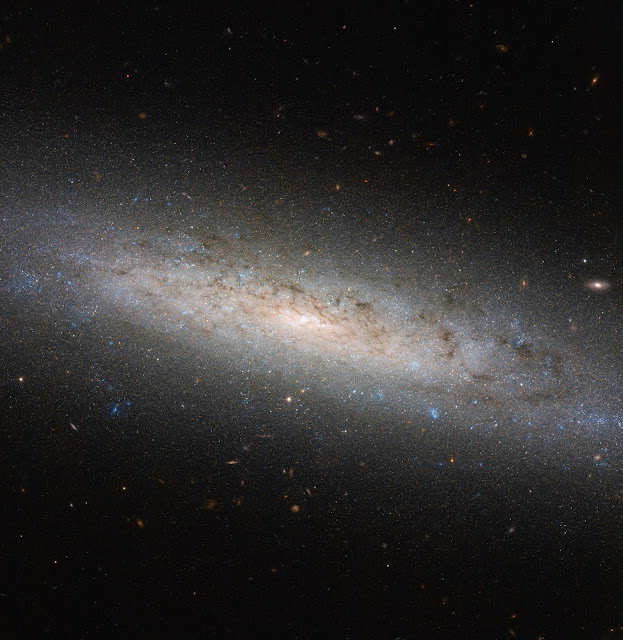
This NASA/ESA Hubble Space Telescope image reveals the vibrant core of the galaxy NGC 3125. Discovered by John Herschel in 1835, NGC 3125 is a great example of a starburst galaxy — a galaxy in which unusually high numbers of new stars are forming, springing to life within intensely hot clouds of gas. Located approximately 50 million light-years away in the constellation of Antlia (The Air Pump), NGC 3125 is similar to, but unfathomably brighter and more energetic than, one of the Magellanic Clouds. Spanning 15 000 light-years, the galaxy displays massive and violent bursts of star formation, as shown by the hot, young, and blue stars scattered throughout the galaxy’s rose-tinted core. Some of these clumps of stars are notable — one of the most extreme Wolf–Rayet star clusters in the local Universe, NGC 3125-A1, resides within NGC 3125. Despite their appearance, the fuzzy white blobs dotted around the edge of this galaxy are not stars, but globular clusters. Found within a galaxy’s halo...
Evolution, Evolutionary history of Life on Earth and Geologic Time Scale

Image
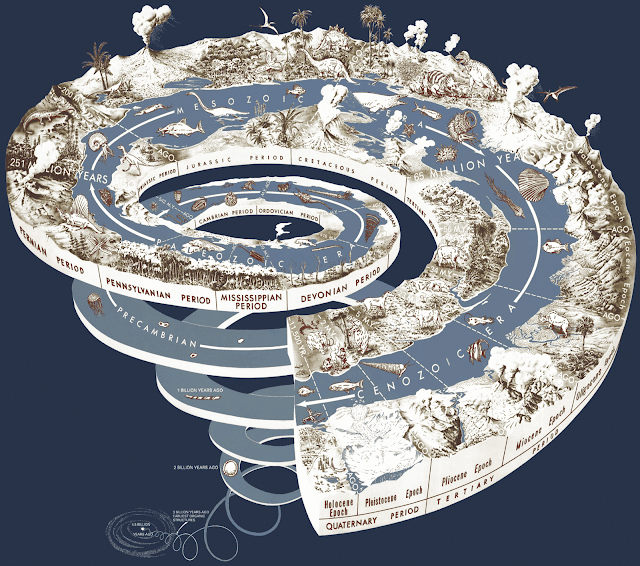
Evolution Evolution is change in the heritable characteristics of biological populations over successive generations. Evolutionary processes give rise to biodiversity at every level of biological organisation, including the levels of species, individual organisms, and molecules. All life on Earth shares a common ancestor known as the last universal common ancestor (LUCA), which lived approximately 3.5–3.8 billion years ago, although a study in 2015 found "remains of biotic life" from 4.1 billion years ago in ancient rocks in Western Australia. In July 2016, scientists reported identifying a set of 355 genes from the LUCA of all organisms living on Earth. Repeated formation of new species (speciation), change within species (anagenesis), and loss of species (extinction) throughout the evolutionary history of life on Earth are demonstrated by shared sets of morphological and biochemical traits, including shared DNA sequences. These shared traits are more similar among species t...

Moonrise seen from the International Space Station

Image
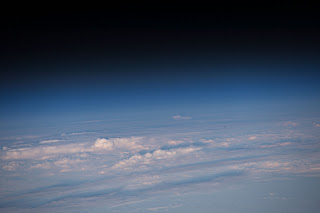
ISS, Orbit of the Earth August 2016 Image Credit: NASA/ESA

Spiral Galaxy NGC 24

Image
This shining disc of a spiral galaxy sits approximately 25 million light-years away from Earth in the constellation of Sculptor. Named NGC 24, the galaxy was discovered by British astronomer William Herschel in 1785, and measures some 40 000 light-years across. This picture was taken using the NASA/ESA Hubble Space Telescope’s Advanced Camera for Surveys, known as ACS for short. It shows NGC 24 in detail, highlighting the blue bursts (young stars), dark lanes (cosmic dust), and red bubbles (hydrogen gas) of material peppered throughout the galaxy’s spiral arms. Numerous distant galaxies can also been seen hovering around NGC 24’s perimeter. However, there may be more to this picture than first meets the eye. Astronomers suspect that spiral galaxies like NGC 24 and the Milky Way are surrounded by, and contained within, extended haloes of dark matter. Dark matter is a mysterious substance that cannot be seen; instead, it reveals itself via its gravitational interactions with surrounding ...

Abiogenesis - Origins of Life on Earth

Image
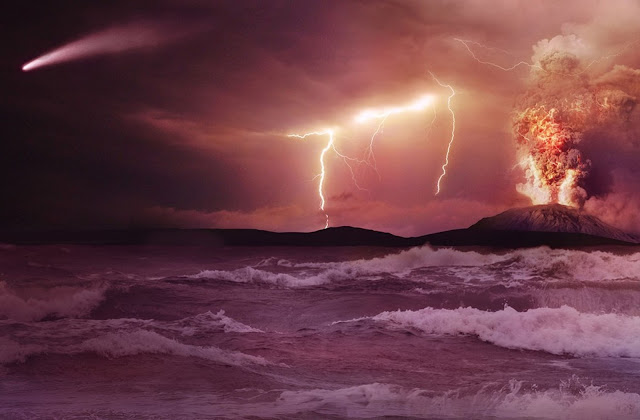
Abiogenesis or biopoiesis or OoL (Origins of Life), is the natural process of life arising from non-living matter, such as simple organic compounds. It is thought to have occurred on Earth between 3.8 and 4.1 billion years ago. Abiogenesis is studied through a combination of laboratory experiments and extrapolation from the characteristics of modern organisms, and aims to determine how pre-life chemical reactions gave rise to life on Earth. The study of abiogenesis involves geophysical, chemical, and biological considerations, with more recent approaches attempting a synthesis of all three. Many approaches investigate how self-replicating molecules, or their components, came into existence. It is generally thought that current life on Earth is descended from an RNA world, although RNA-based life may not have been the first life to have existed. The classic Miller–Urey experiment and similar research demonstrated that most amino acids, the basic chemical constituents of the proteins use...

Sunset seen from the International Space Station

Image
ISS, Orbit of the Earth August 2016 Image Credit: NASA/ESA

Reflection Nebula BFS 29

Image
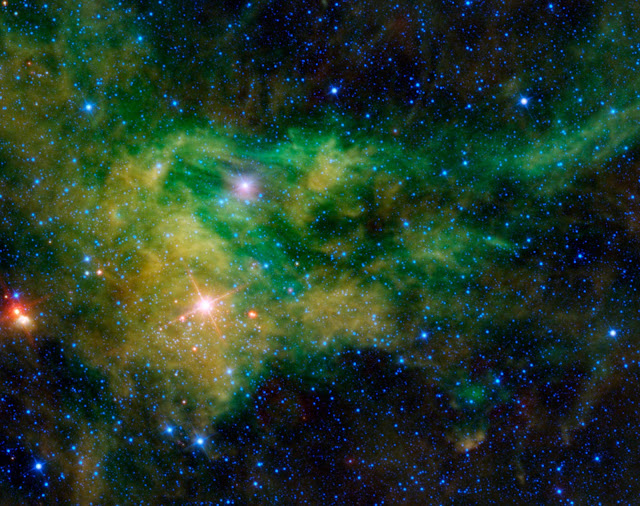
NASA's Wide-field Infrared Survey Explorer, or WISE, captured this colorful image of the nebula BFS 29 surrounding the star CE-Camelopardalis, found hovering in the band of the night sky comprising the Milky Way. Most of the gas and dust in this image cannot be seen directly in visible light, but WISE's detectors revealed exquisite new details, and even some hidden stars. The nebulous interstellar gas and dust in this image is known as BFS 29. "BFS" stands for Blitz, Fich, and Stark -- the three astronomers who identified and catalogued 65 new star-forming regions in 1982 (the "29" simply means that it's the 29th object in their catalog). In visible light, BFS 29 can be seen, but only very slightly. This is because the dust scatters and reflects some of the light from nearby stars, hence its classification as a reflection nebula. The gas in BFS 29 also contains large amounts of ionized hydrogen -- referred to by astronomers as "H II." Hence, th...