Posts

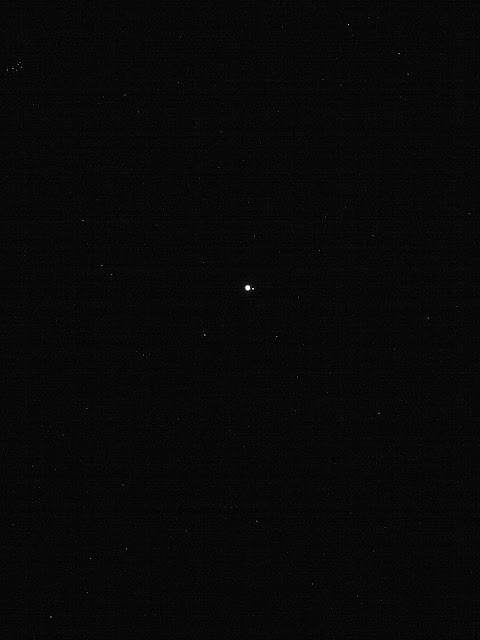
Earth and Moon seen by OSIRIS-REx spacecraft from 63 million kilometers away
Image
As part of an engineering test, NASA’s OSIRIS-REx spacecraft captured this image of the Earth and Moon using its NavCam1 imager on January 17 from a distance of 39.5 million miles (63.6 million km). When the camera acquired the image, the spacecraft was moving away from home at a speed of 19,000 miles per hour (8.5 kilometers per second). Earth is the largest, brightest spot in the center of the image, with the smaller, dimmer Moon appearing to the right. Several constellations are also visible in the surrounding space. The bright cluster of stars in the upper left corner is the Pleiades in the Taurus constellation. Hamal, the brightest star in Aries, is located in the upper right corner of the image. The Earth-Moon system is centered in the middle of five stars comprising the head of Cetus the Whale. NavCam1, a grayscale imager, is part of the TAGCAMS (Touch-And-Go Camera System) navigation camera suite. Malin Space Science Systems designed, built, and tested TAGCAMS; Lockheed Martin ...
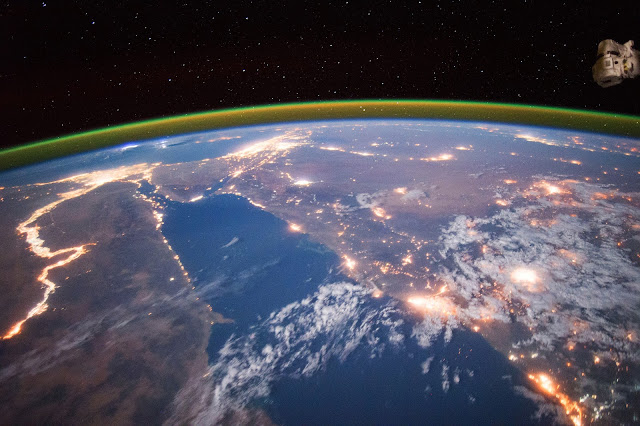
The Nile at Night seen from the International Space Station

Image
September 22, 2015 Image Credit: NASA

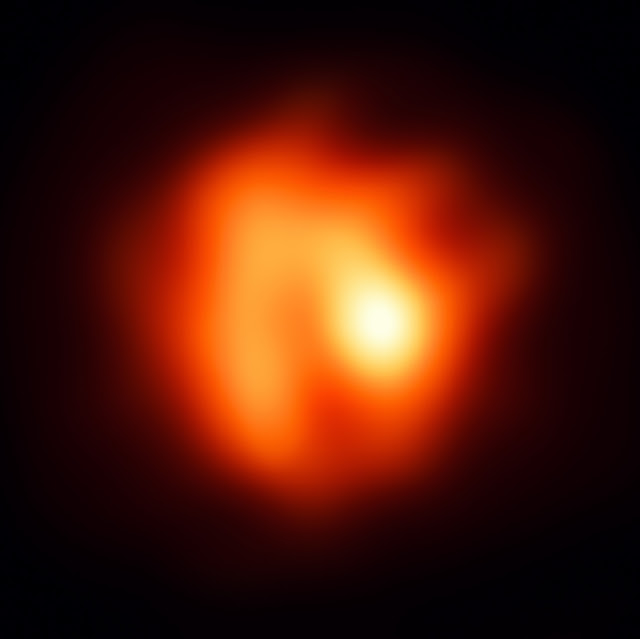
R Sculptoris

Image
This ghostly image features a distant and pulsating red giant star known as R Sculptoris. Situated 1200 light-years away in the constellation of Sculptor, R Sculptoris is something known as a carbon-rich asymptotic giant branch (AGB) star, meaning that it is nearing the end of its life. At this stage, low- and intermediate-mass stars cool off, create extended atmospheres, and lose a lot of their mass — they are on their way to becoming spectacular planetary nebulae. While the basics of this mass-loss process are understood, astronomers are still investigating how it begins near the surface of the star. The amount of mass lost by a star actually has huge implications for its stellar evolution, altering its future, and leading to different types of planetary nebulae. As AGB stars end their lives as planetary nebulae, they produce a vast range of elements — including 50% of elements heavier than iron — which are then released into the Universe and used to make new stars, planets, moons, a...

Spiral Galaxy NGC 1559

Image
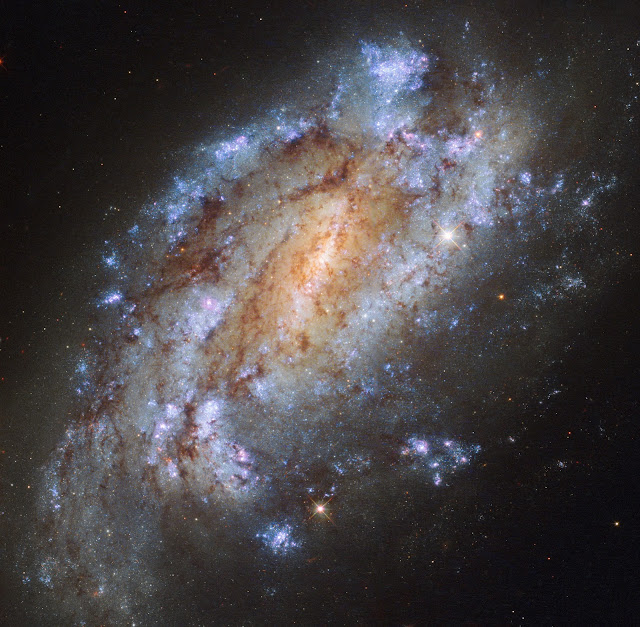
Roughly 50 million light-years away lies a somewhat overlooked little galaxy named NGC 1559. Pictured here by Hubble’s Wide Field Camera 3, this barred spiral lies in the little-observed southern constellation of Reticulum (The Reticule). NGC 1559 has massive spiral arms chock-full of star formation, and is receding from us at a speed of about 1300 km/s. The galaxy contains the mass of around ten billion Suns — while this may sound like a lot, that is almost 100 times less massive than the Milky Way. Although NGC 1559 appears to sit near one of our nearest neighbours in the sky — the Large Magellanic Cloud (LMC), this is just a trick of perspective. In reality, NGC 1559 is physically nowhere near the LMC in space — in fact, it truly is a loner, lacking the company of any nearby galaxies or membership of any galaxy cluster. Despite its lack of cosmic companions, when this lonely galaxy has a telescope pointed in its direction, it puts on quite a show! NGC 1559 has hosted a variety of sp...

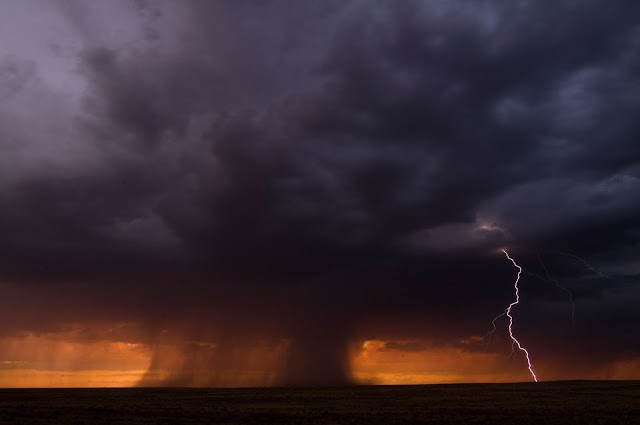
Storm and Lightning over Petrified Forest National Park

Image
Navajo, Arizona Image Credit: Ralph Lauer, ZUMA Press/Corbis

Spotless Sun

Image
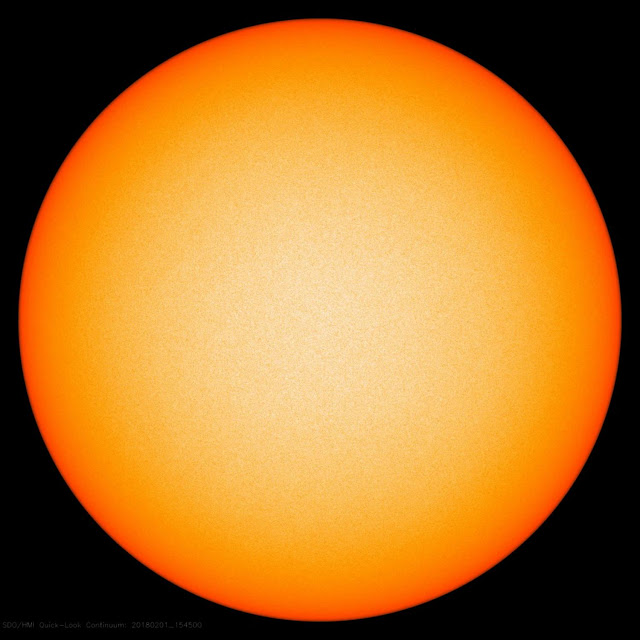
The Sun has had no sunspots for almost two weeks (as of February 1, 2018) and just has a single, tiny one that appeared on January 31, 2018. This spotless period is a prelude to the approaching period of solar minimum next year, when the Sun's activity will be at the low end of its 11-year cycle. Image Credit: NASA/GSFC/Solar Dynamics Observatory Explanation from: https://photojournal.jpl.nasa.gov/catalog/PIA22242

Rhea and Titan

Image
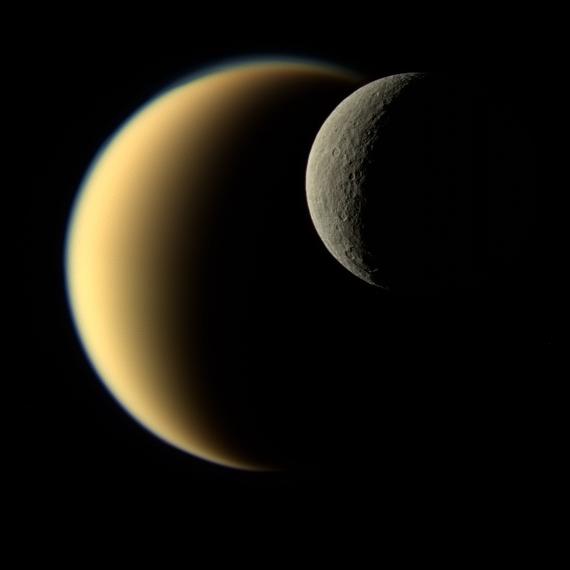
In this view, Saturn's icy moon Rhea passes in front of Titan as seen by NASA's Cassini spacecraft. Some of the differences between the two large moons are readily apparent. While Rhea is a heavily-cratered, airless world, Titan's nitrogen-rich atmosphere is even thicker than Earth's. This natural color image was taken in visible light with the Cassini narrow-angle camera on November 19, 2009, at a distance of approximately 713,300 miles (1,148,000 kilometers) from Rhea. The Cassini spacecraft ended its mission on September 15, 2017. Image Credit: NASA/JPL-Caltech/Space Science Institute Explanation from: https://photojournal.jpl.nasa.gov/catalog/PIA21904