An X9.3 class solar flare flashes in the middle of the Sun on September 6, 2017. This image was captured by NASA's Solar Dynamics Observatory at 11:58:20UT and shows light in the 131 angstrom wavelength.
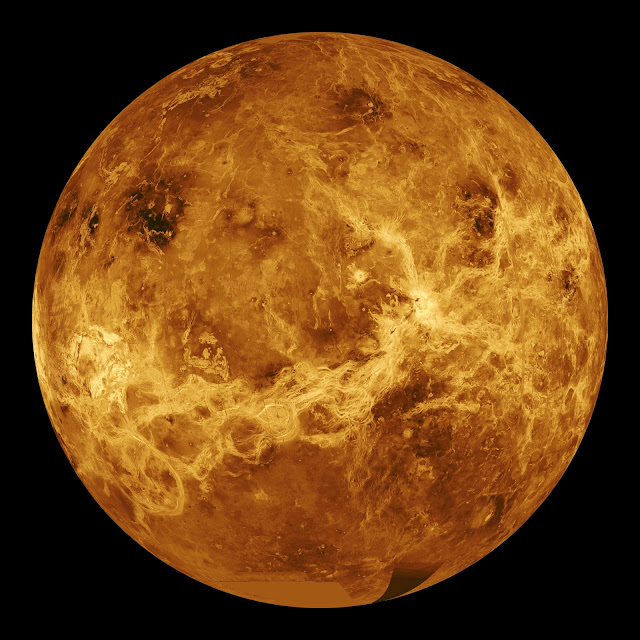
Venus is the second planet from the Sun, orbiting it every 224.7 Earth days. It has the longest rotation period (243 days) of any planet in the Solar System and rotates in the opposite direction to most other planets. It has no natural satellite. It is named after the Roman goddess of love and beauty. It is the second-brightest natural object in the night sky after the Moon, reaching an apparent magnitude of −4.6, bright enough to cast shadows. Because Venus is an inferior planet from Earth, it never appears to venture far from the Sun; its elongation reaches a maximum of 47.8°. Venus is a terrestrial planet and is sometimes called Earth's "sister planet" because of their similar size, mass, proximity to the Sun, and bulk composition. It is radically different from Earth in other respects. It has the densest atmosphere of the four terrestrial planets, consisting of more than 96% carbon dioxide. The atmospheric pressure at the planet's surface is 92 times that of Earth...
TRAPPIST-1e (also known as 2MASS J23062928-0502285 e) is an exoplanet, likely rocky, orbiting within the habitable zone around the ultracool dwarf star TRAPPIST-1 approximately 40 light-years (12.1 parsecs) away from Earth in the constellation of Aquarius. The exoplanet was found by using the transit method, in which the dimming effect that a planet causes as it crosses in front of its star is measured. It was one of seven new exoplanets to be discovered orbiting the star using observations from the Spitzer Space Telescope. The exoplanet is within the star's habitable zone. Mass, radius, and temperature TRAPPIST-1e is an Earth-sized exoplanet, meaning it has a mass and radius close to that of Earth. It has an equilibrium temperature of 251.3 K (−22 °C; −7 °F), which is close to Earth's equilibrium temperature. It has a radius of around 0.92 R⊕ and a mass of 0.62 M⊕. It also has a similar density to Earth as well. Host star The planet orbits an (late M-type) ultracool dwarf star...
The natural evolution of the Sun made it progressively more luminous during the Archean and Proterozoic eons; the Sun's luminosity increases 6% every billion years. As a result, the Earth began to receive more heat from the Sun in the Proterozoic eon. However, the Earth did not get warmer. Instead, the geological record seems to suggest it cooled dramatically during the early Proterozoic. Glacial deposits found in South Africa date back to 2.2 Ga, at which time, based on paleomagnetic evidence, they must have been located near the equator. Thus, this glaciation, known as the Makganyene glaciation, may have been global. Some scientists suggest this was so severe that the Earth was totally frozen over from the poles to the equator, a hypothesis called Snowball Earth. The ice age around 2.3 Ga could have been directly caused by the increased oxygen concentration in the atmosphere, which caused the decrease of methane (CH4) in the atmosphere. Methane is a strong greenhouse gas, but wit...



Comments
Post a Comment