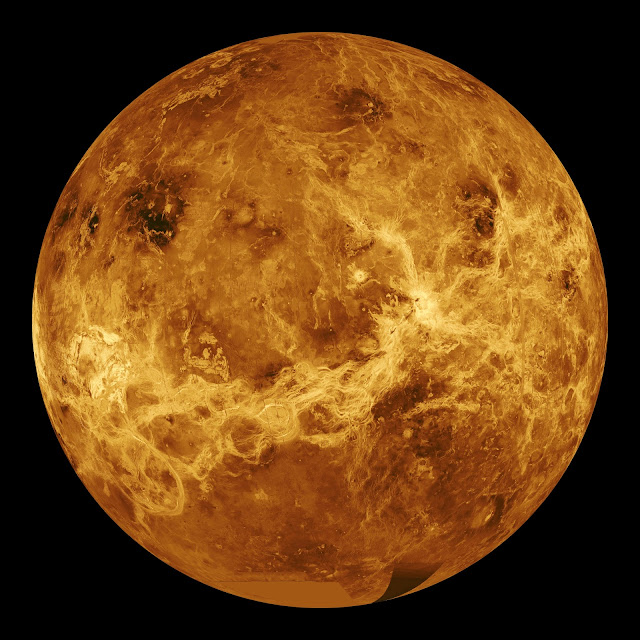
Venus is the second planet from the Sun, orbiting it every 224.7 Earth days. It has the longest rotation period (243 days) of any planet in the Solar System and rotates in the opposite direction to most other planets. It has no natural satellite. It is named after the Roman goddess of love and beauty. It is the second-brightest natural object in the night sky after the Moon, reaching an apparent magnitude of −4.6, bright enough to cast shadows. Because Venus is an inferior planet from Earth, it never appears to venture far from the Sun; its elongation reaches a maximum of 47.8°. Venus is a terrestrial planet and is sometimes called Earth's "sister planet" because of their similar size, mass, proximity to the Sun, and bulk composition. It is radically different from Earth in other respects. It has the densest atmosphere of the four terrestrial planets, consisting of more than 96% carbon dioxide. The atmospheric pressure at the planet's surface is 92 times that of Earth...
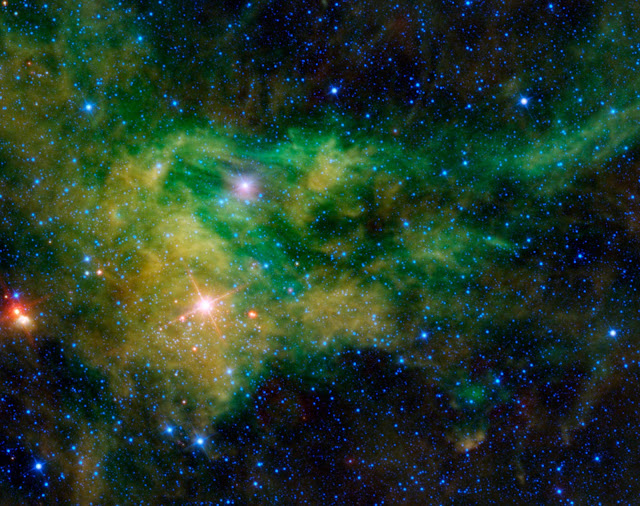
NASA's Wide-field Infrared Survey Explorer, or WISE, captured this colorful image of the nebula BFS 29 surrounding the star CE-Camelopardalis, found hovering in the band of the night sky comprising the Milky Way. Most of the gas and dust in this image cannot be seen directly in visible light, but WISE's detectors revealed exquisite new details, and even some hidden stars. The nebulous interstellar gas and dust in this image is known as BFS 29. "BFS" stands for Blitz, Fich, and Stark -- the three astronomers who identified and catalogued 65 new star-forming regions in 1982 (the "29" simply means that it's the 29th object in their catalog). In visible light, BFS 29 can be seen, but only very slightly. This is because the dust scatters and reflects some of the light from nearby stars, hence its classification as a reflection nebula. The gas in BFS 29 also contains large amounts of ionized hydrogen -- referred to by astronomers as "H II." Hence, th...
Nestled in the young Ophiuchus star-forming region, 410 light-years from the Sun, a fascinating protoplanetary disc named AS 209 is slowly being carved into shape. This wonderful image was captured using the high-resolution ALMA telescope, revealing a curious pattern of rings and gaps in the dust surrounding a young star. Protoplanetary discs are dense, rotating planes of gas and dust that surround newly formed stars; providing the matter that one day becomes orbiting planets, moons and other minor bodies. At less than one million years old, this system is very young, but already two clear gaps are being sculpted from the disc. The outer gap is deep, wide, and largely a dust-free zone, leading astronomers to believe that a giant planet almost the mass of Saturn is orbiting here — around 800 light-minutes from the central star, and more than three times the distance between Neptune and the Sun! As the planet carves out its path, dust piles up at the outer edge of its orbit, creating eve...


Comments
Post a Comment